
The Complete Guide to Home EV Charger Installation
Your electrical panel doesn’t know you bought an EV. It just knows how much load it can carry — and for a lot of homes, that’s the first problem nobody mentions until the installer shows up.
This is the guide we wish every homeowner had before they called anyone. What charger you actually need, what your panel can and can’t handle, what the permit process looks like, and what a real installation day looks like from start to finish.
Level 1, Level 2, or DCFC — What Your Home Actually Needs
Almost no homeowner needs DC fast charging (DCFC) — that’s for public charging stations and commercial fleets, not a garage. The real decision is Level 1 vs. Level 2.
Level 1 runs off a standard 120V outlet — the same one your washer uses. It works. It’s also slow: 3–5 miles of range per hour of charging. Fine if your car sits overnight and your commute is short. Not fine if you drive more than you sleep.
Level 2 runs on a 240V circuit — the same voltage as your dryer or oven — and delivers 20–40+ miles of range per hour. This is what most homeowners end up installing, and it’s the standard for a reason: it reliably tops off a depleted battery overnight, without you having to think about it.
The honest answer: if you’re buying or leasing an EV as a daily driver, get Level 2. Level 1 is a stopgap, not a solution.
There’s also a household-math reason Level 2 makes sense even if you’re not driving every day: most homes don’t have just one car. One Level 2 charger is fast enough that multiple vehicles can take turns on it — instead of every car needing to charge every night, each one “fills up” on its own schedule, often just once a week or so depending on how much you actually drive. You don’t need one charger per car to keep a multi-car household running.
Does Your Panel Have Room for This?
This is the question that gets skipped and shouldn’t be. A Level 2 charger draws a real, continuous load — and a lot of older homes are running panels sized for an era before central air, induction ranges, and EVs all wanted power at the same time.
Two things determine whether your panel is ready:
- Panel amperage. Homes built before the 1990s often have 100A service. A Level 2 charger circuit alone can need 40–60A. That doesn’t leave much room once you account for everything else already running.
- Available capacity, not just panel size. A 200A panel that’s already maxed out with existing circuits can be just as constrained as a 100A panel with headroom. This is a load calculation, not a guess.
Two situations tend to need the closest look: homes built before the 1990s (smaller original service, more likely to be near or over capacity already), and multifamily buildings, including condos — shared electrical infrastructure adds its own set of questions we won’t get into here (that’s its own topic — see below).
If the calculation comes back short, you’re not stuck with one option. A panel upgrade is the most direct fix, but it’s not the only one — some homeowners are better served by a load management system instead, which intelligently shares your existing capacity across circuits (including the charger) rather than adding more of it. We’re not going to get into how those work in this post — that’s a full topic on its own we’ll be covering soon — but it’s worth knowing the option exists before you assume a panel upgrade is the only path.
Here’s roughly how the main options compare, including two that go beyond just the charger question:
| Option | Solves EV charging capacity | Keeps essentials running in an outage | Can lower utility costs | Relative cost | Best fit when… |
|---|---|---|---|---|---|
| Load management system | Yes — shares existing capacity | No | Not directly | $ | Your panel is close but not quite short, and you’d rather not do a full upgrade |
| Larger-capacity panel | Yes — adds real headroom | No | Not directly | $$ | Your panel is genuinely maxed out, or you’re planning more electrical load beyond the charger |
| Panel upgrade + load management | Yes — most headroom and flexibility | No | Not directly | $$–$$$ | You want room to grow (charger now, more later) without guessing at exact sizing |
| Battery backup | Only if paired with a panel or load-management fix | Yes, for the circuits it’s wired to | Depends on your utility’s rate structure | $$$ | Outages are a real concern, or you’re already adding solar |
| Emergency generator | Only if paired with a panel or load-management fix | Yes, whole-home or partial depending on sizing | No | $$–$$$ | You want outage coverage without battery/solar, especially for longer outages |
| Solar | Only if paired with a panel or load-management fix | Only with battery storage added | Typically, yes | $$$–$$$$ | You’re looking at long-term utility cost reduction, not just charging capacity |
This is a snapshot, not a recommendation — which combination makes sense depends on your panel, your home, and what you’re actually trying to solve. A panel upgrade happens before the charger, not instead of it, in most straightforward cases — same project, same visit, one invoice.
→ Does your panel need an upgrade before an EV charger? See our panel upgrade service
Which Charger Should You Actually Buy?
Every Level 2 charger does the same basic job — the differences are in speed, smart features, and who’s allowed to install them.
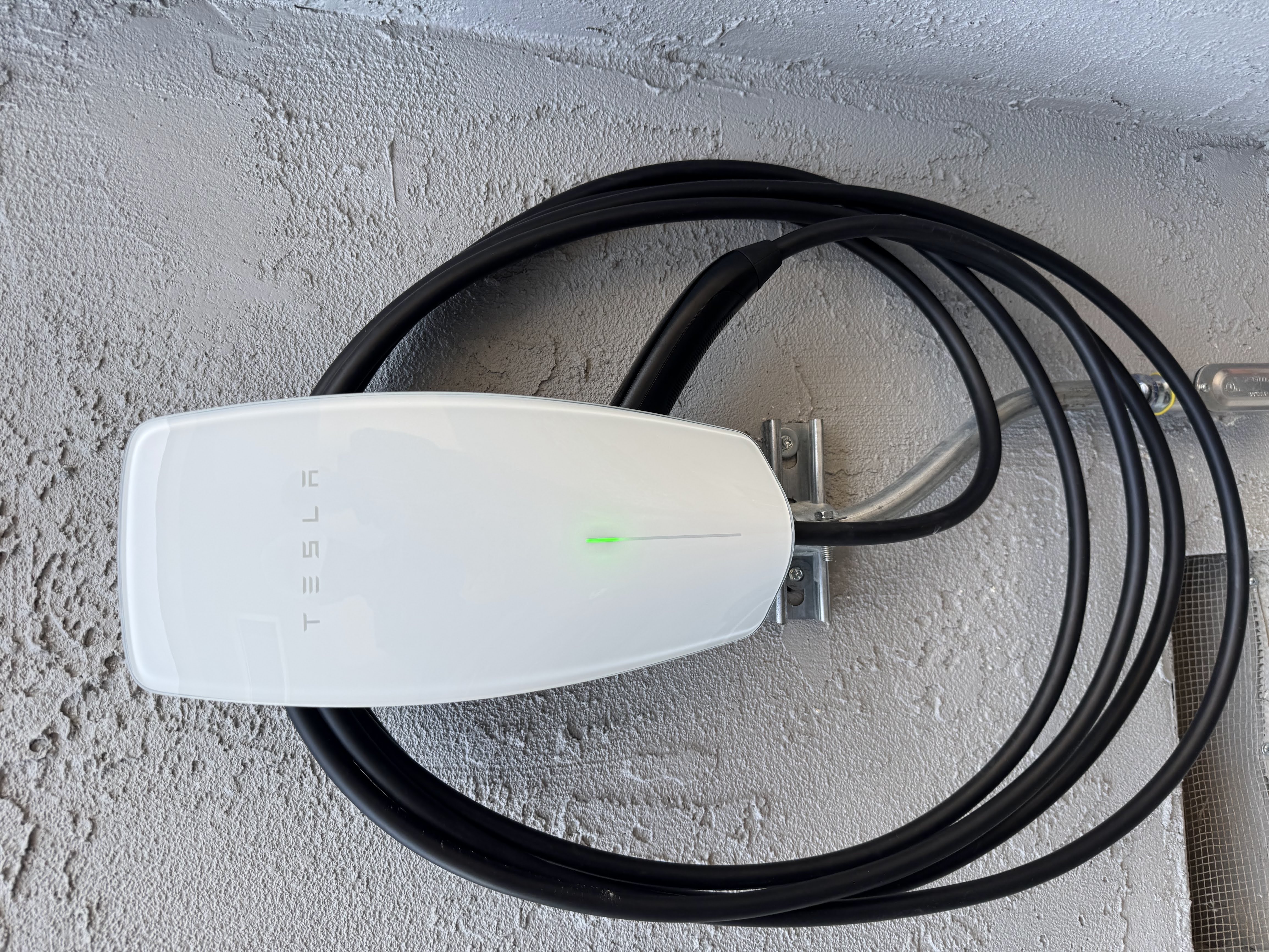
We’re a Tesla Wall Connector Certified Installer, which means Tesla has certified our work specifically for their hardware — not a blanket EV certification, a specific one. If you’re driving a Tesla, the Wall Connector is purpose-built for it: faster charging than a generic Level 2 unit, and it integrates with Tesla’s own charging schedule and app.
Worth knowing: the Wall Connector isn’t Tesla-only anymore. Tesla also makes a Universal Wall Connector, built with both a Tesla connector and a J1772 adapter, so it charges non-Tesla EVs from the same unit. That’s possible because Tesla’s own connector design — NACS (North American Charging Standard) — has since been adopted as the industry standard, not just a Tesla thing. Automakers including Ford, GM, Rivian, and Mercedes-Benz now build NACS ports into new vehicles, and major charging networks — ChargePoint, EVgo, and Electrify America among them — have added or announced NACS support alongside the older connector types.
If you’re not driving a Tesla, a universal Level 2 charger with a standard J1772 connector still covers every other EV on the road today. We’re a ChargePoint Approved Installer as well — so whichever platform your car points you toward, the certification behind the install is the same. The right choice depends on the car in your driveway, not brand preference — we’ll help you sort out which unit actually fits your situation.
Permits — What’s Required and How Long It Takes
Every EV charger installation requires an electrical permit. This isn’t optional and it isn’t a formality — it’s what makes sure the circuit was inspected and sized correctly, and it’s what protects you if anything is ever questioned by an insurer or a future buyer’s inspector.
The general shape of the process:
- Permit application submitted to the local Authority Having Jurisdiction (AHJ) — this varies city by city
- Rough inspection after the circuit is run, before it’s closed up
- Final inspection after the charger is mounted and energized
Turnaround time depends entirely on which city’s permit office is handling it — we’ll tell you the current expected timeline for your specific address when we submit your permit, rather than quoting a number here that may not match what your city is running this month.
We pull every permit ourselves. If a quote doesn’t include permitting, that’s a quote for unpermitted work — and unpermitted electrical work is a real liability if you ever sell the house.
EV Charging for Condos, Apartments, and HOAs
Multi-family EV charging is a different problem than a single-family garage — usually it’s about shared electrical infrastructure and who pays for what, not just running a circuit.
Smart Level 2 charging systems built for multi-unit buildings can manage several charging stations on shared panel capacity without every unit needing its own major electrical upgrade. This matters for HOAs fielding EV requests from multiple residents and for property owners trying to add charging without a full electrical service upgrade to the building.
We’re not covering the specifics here on purpose — multifamily and HOA charging has its own set of questions (who owns the circuit, how costs get split, HOA approval process) that deserve a dedicated post rather than a few paragraphs at the bottom of this one. That’s coming separately.
→ Installing in a condo, apartment or ADU? See how we handle multi-family charging
[Section held] A SPAN Panel + EV Charger section is drafted but not included here — it names a credential (SPAN Panel Approved Installer) that’s confirmed-accurate but not yet approved to ship publicly (see B-028). Will add once cleared.
What Installation Day Actually Looks Like
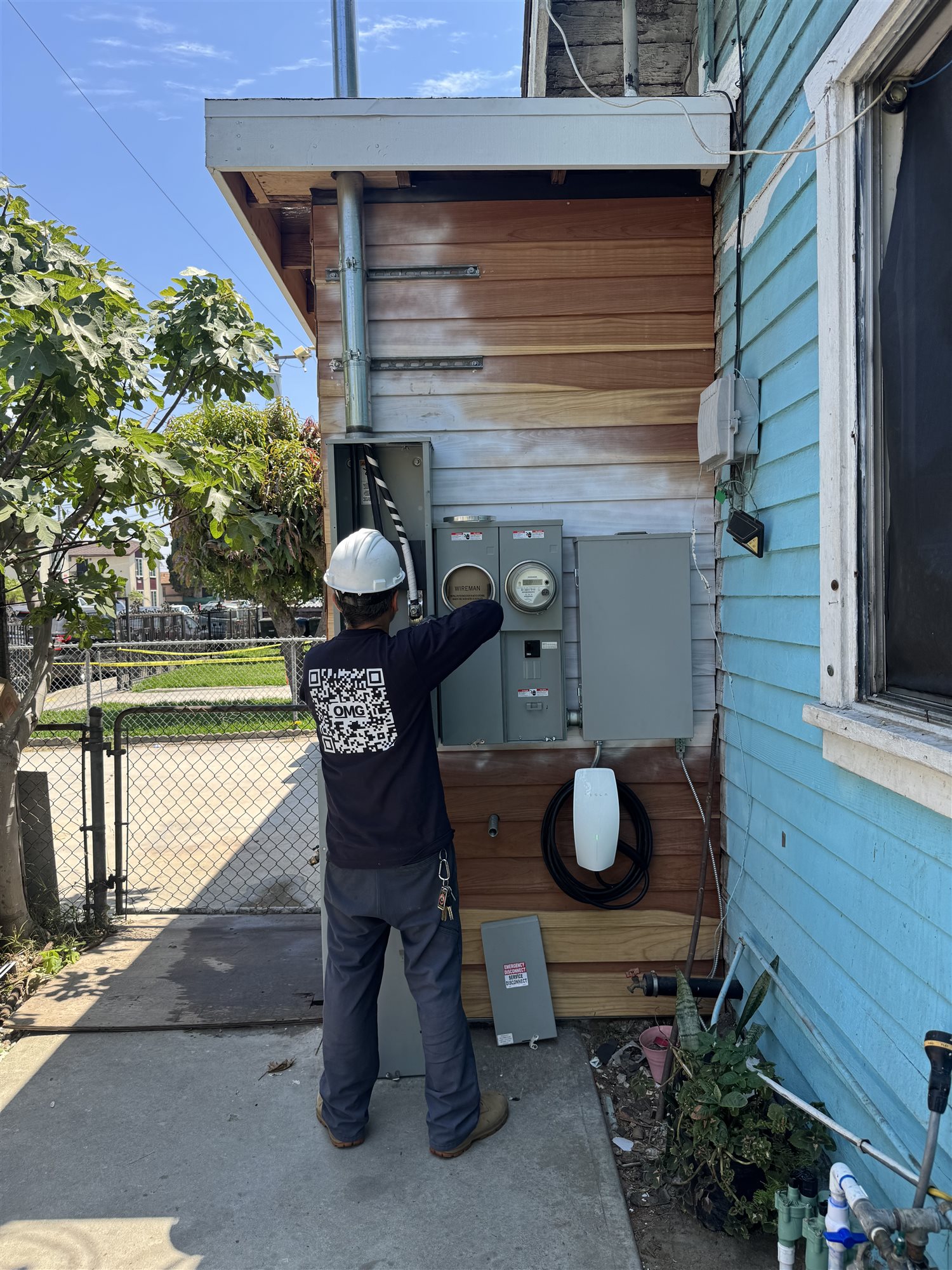
Most straightforward installs — panel already has capacity — are done in a single day. If a panel upgrade is needed first, plan for the panel work plus the charger circuit, sequenced so permits and inspections don’t create unnecessary delay between phases.
A typical day:
- Final walkthrough — confirm charger location and route
- Circuit run from panel to mounting location
- Charger mounted and wired
- Circuit tested and energized
- Walkthrough with you — how to use it, what the indicator lights mean
What This Actually Costs
Real numbers vary by home, panel condition, and charger type — anyone who quotes a flat price before seeing your panel is guessing.
What we can tell you without guessing: panel-ready installs cost meaningfully less than projects that need a panel upgrade first — and if yours needs the panel work, that’s where the real money is. Qualifying homeowners may receive up to $2,100 toward a panel upgrade, based on the home, its location, and the project itself. Not everyone qualifies, and the amount depends on your address and available funding. Check your address → for a preliminary look, or see how panel upgrade savings work →. We confirm what actually applies to your specific address at your estimate — before anything is signed.
→ What home EV charger installation actually involves, and what drives the cost → Related: How to get help paying for a panel upgrade
Choosing an Installer
Not every electrician who says “I can install that” is certified to. Look for:
- C-10 license, verified — ours is #1100745, checkable on the CSLB website
- Manufacturer certification for the specific charger brand — Tesla certification is per-product, not blanket
- Someone who pulls permits — every time, no exceptions
- One person accountable for the whole job — not a rotating crew with no single point of responsibility
Next Step
Your panel might be ready for an EV charger right now — or it might need a look first. Either way, the only way to know is a real assessment, not a guess over the phone.